

COP communications can no longer be built around announcements, stages and social content alone. As scrutiny shifts from ambition to implementation, GCC organisations need evidence-led claims, clearly defined executive authority, bilingual precision, geopolitical judgement and a post-summit accountability system capable of surviving the attention they work so hard to attract.
At COP, the press release is no longer the end of a climate claim. It is the beginning of its audit.
For communications leaders, that changes the assignment. COP is not a two-week campaign for panels, photographs and event-calendar activity. It is a year-round reputation stress test in which claims are examined against operating performance, capital allocation, policy positions, partnerships and previous promises.
For GCC organisations, the opportunity is substantial. So is the exposure.
From announcements to accountability
Recent COPs tell a clear communications story. At COP26, unprecedented media and social volume showed how quickly generic commitments could disappear into the noise. COP27 shifted the conversation towards loss and damage, adaptation and the human consequences of climate change.
COP28, hosted in Dubai and attended by some 85,000 participants, brought the first Global Stocktake and the call to transition away from fossil fuels in energy systems, pushing scrutiny much closer to the core business: investment plans, methane, Scope 3 emissions, lobbying positions and the use of offsets.
COP29 placed financial claims under greater scrutiny, forcing organisations to distinguish between what was announced, committed, mobilised and actually deployed. COP30 reinforced the shift towards implementation and information integrity.
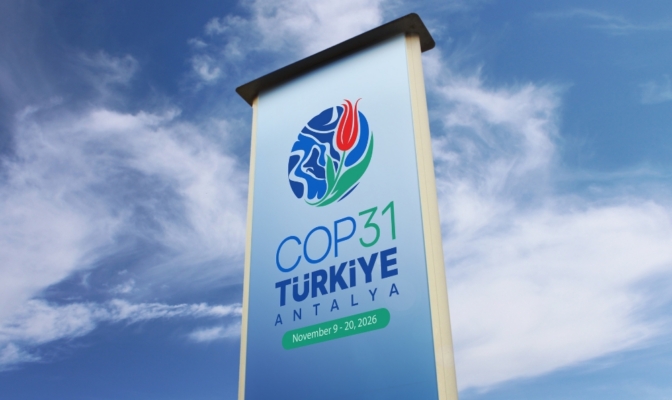
And COP31 in Antalya continues that trajectory, with an agenda increasingly focused on implementation, investability and measurable results. Ambition still matters. Proof of implementation matters more.
The GCC visibility paradox
The Gulf has genuine authority in this conversation. Regional organisations are building renewable power, grids, industrial capacity, finance platforms, water systems, cooling and resilient infrastructure at scale. Yet the region’s centrality to energy, aviation, heavy industry and state-led investment also creates a scrutiny premium.
Communications teams should stop treating share of voice as the objective. The better measure is share of credible voice: visibility attached to a material issue, defensible evidence, accurate message pull-through, independent validation, a relevant executive and useful content that survives beyond the summit.
The CEO should not automatically front every subject. A technical leader may be more convincing on methane measurement; a finance executive on capital mobilisation; an operations leader on delivery. Every spokesperson needs a defined authority territory, access to evidence and preparation for difficult questions and trade-offs, not simply approved slogans. Ideally, media coaching will not be left to the last minute.
Precision must extend across languages and political contexts. “Transition away”, “phase-down”, “net zero”, “avoided emissions”, “offset”, “mobilised capital” and “deployed capital” are not interchangeable. Arabic and English materials require technical and political equivalence, not mechanical translation. Executives must distinguish between what their company controls, what it advocates, what government determines and what Parties have formally negotiated.
Build the operating system
Before COP, the content plan and the claims register need to move as a pair, think champagne and a cork: one creates the excitement, the other stops things getting messy. Every material statement should be mapped to its scope, baseline, methodology, assurance status, exclusions and owner.
They need a digital evidence room, a permission-to-speak matrix, an approved bilingual terminology guide, partner due diligence, hostile-question preparation and clear triggers for pausing content during a geopolitical, humanitarian or reputational event.
During the summit, communications should operate through a central command structure. Daily policy and geopolitical intelligence must inform executive briefings, media response and content decisions. Green, amber and red approval lanes can separate routine facts from policy interpretation and genuine incidents. A canonical newsroom should hold the authoritative version of every claim. Monitoring must cover not only mentions, but narrative shifts, misinformation, critical voices, partner controversies and whether planned communications remain appropriate.
Immediately afterwards, resist the pre-written victory statement. Final COP texts are negotiated documents; Presidency objectives, voluntary initiatives, national policies and corporate announcements are different categories. First establish what was agreed, what remains unresolved and what changes for the organisation. Then translate the outcome for employees, investors, customers, government and media.
Every public commitment should enter a ledger with an owner, baseline, deadline, investment requirement and reporting dates at 30, 90, 180 and 365 days. Where delivery slips, explain why and what changes next.
The organisations that build authority around COP will not necessarily be the loudest in the room. They will be those whose evidence, judgement and commitments still withstand scrutiny when the pavilion has closed and the next reporting cycle begins.
The real measure of authority begins after the headlines fade, when promises meet performance and scrutiny moves from what was said to what was delivered. Anyone can buy visibility for two weeks. The harder task is earning the right to still be believed a year later.
Originally published in Campaign Middle East
Contact
Amel Osman, Managing Director, Middle East
Dubai
[email protected]