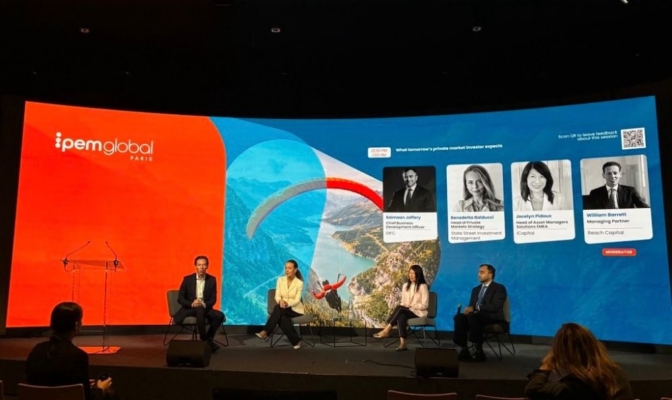
H/Advisors attended its 11th IPEM conference, IPEM Global 2026, in Paris. What began as a predominantly French gathering has evolved into a truly international event, attracting more than 6,600 attendees from 65 countries, including 1,100 limited partners (LPs) representing private equity, private credit, venture capital, infrastructure and real estate.
Under the theme ‘Mastering the course’, LPs, GPs and other industry players explored how the alternatives sector can navigate an increasingly complex global environment while continuing to generate the above-average returns upon which pension funds, institutional investors and private savers depend. As a reminder, the alternative sectors equity assets under management (AUM) stand at approximately $10.5 trillion, while global private credit AUM is estimated at between $2 trillion and $3.5 trillion, depending on the inclusion of asset-backed finance and alternative debt structures.
Despite continued geopolitical uncertainty and market volatility, the mood throughout the conference was one of cautious optimism. Following the interest rate shock of 2022, several participants suggested that “green shoots are flourishing.” While previous editions of IPEM focused heavily on impact investing and the growing role of retail investors in private markets, this year’s dominant topic was unsurprisingly artificial intelligence.
IPEM CEO Antoine Colson summarised the challenge facing the industry:
“You need to understand the wind to master the course, and there is no shortage of wind.”
01 AI: The new playbook for value-creation
A recurring theme across discussions was the transformative impact AI will have on private markets. Steffen Meister of Partners Group and Guillaume Princen of Anthropic both emphasised that AI is reshaping how private equity firms create value. As AI accelerates operational improvements within portfolio companies, firms are likely to require broader and deeper operating capabilities, while traditional sector expertise may become somewhat less vital. That said, many stressed the importance of the “human touch”, which is ultimately what allows GPs to drive value creation and stand out from the crowd.
Participants broadly agreed that the global economy could undergo significant structural changes over the coming decade, requiring investors to reassess business models and operational strategies. For private equity owners, this means continually evaluating how AI can enhance portfolio companies’ performance and competitiveness. Staying ahead of the AI curve, and successfully bringing portfolio companies along that journey, was widely viewed as a critical driver of future returns.
02 A market showing signs of resilience
Research presented by AlixPartners at IPEM suggested that liquidity concerns remain for investors amid persistent economic uncertainty and continuing valuation gaps between buyers and sellers. However, there was also a strong sense that opportunities remain abundant for managers focused on long-term value creation.
According to IPEM and AlixPartners research, LPs are expected to allocate more than €110 billion to alternative assets over the next 12 months, highlighting sustained confidence in the asset class. This ongoing flow of capital appears well-timed. As Scott Kleinman of Apollo Global Management observed, “We are in a golden age of capital deployment,” driven by enormous investment requirements across digital infrastructure, energy transition and industrial development.
03 Private credit remains in focus
Private credit continued to attract significant attention following a summer marked by redemption pressures at several managers. Nevertheless, industry leaders remained confident in the overall health of the asset class. According to Blair Jacobson of Ares, private credit remains resilient. He stated: “Growing demand for computing power, cloud infrastructure and AI is driving significant capital needs across data centres and the wider digital ecosystem, while secondaries and asset-based finance are gaining momentum”. Scott Kleinmann of Apollo argued that: “We will have a credit cycle but not just yet. Credit is healthy, spreads are fine and the global economy is strong”.
04 Quality, culture and the human advantage
A consistent message throughout the conference was that, in a higher-rate environment characterised by geopolitical uncertainty, asset quality matters more than ever. Resilient, market-leading businesses are better positioned to navigate volatility and provide multiple pathways to liquidity, enabling managers to deliver the ‘alpha’ that investors expect. Yet amid all the discussion around technology and market dynamics, one competitive advantage was repeatedly identified as irreplaceable: culture.
From investment decision-making to portfolio company transformation, culture remains central to how firms adapt to change and execute successfully. Industry leaders argued that investment managers must be more forward-looking, agile and adaptable than ever before. The growing participation of wealth and retail investors in private markets has added complexity to the industry, creating new expectations around liquidity, transparency and communication. However, several speakers noted that the quality of fund managers has increased dramatically over the past quarter century, leaving the industry well-equipped to meet these challenges.
Looking ahead
The overarching conclusion from IPEM Global 2026 was clear: the alternatives industry has no time to waste. As AI advances at unprecedented speed and geopolitical shifts reshape markets with increasing frequency, investment managers must remain flexible, both in how they operate and how they evaluate opportunities. Success will depend on combining technological innovation with the industry’s enduring strengths: deep expertise, enduring relationships, disciplined execution and human judgement.
After a busy and insightful week in Paris filled with discussions, networking and new perspectives, H/Advisors is already looking ahead to IPEM Wealth 2027 in Cannes, where the industry will reconvene under the theme “The Accelerator of Private Markets’ Wealth Revolution.”